Freelance Web Designer vs Web Design Agency: Which is Right for You?
Freelance Web Designer vs Web Design Agency — which one is right for your project? Compare costs, UX expertise, design processes, scalability, and long-term value to make the right choice for your website, SaaS product, or digital platform.September 22, 2026
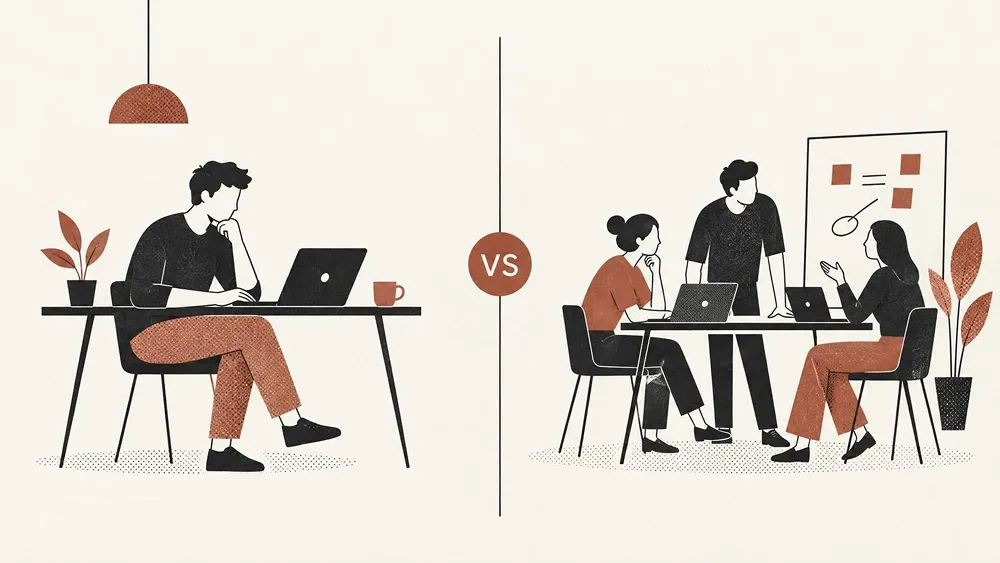
Table of contents
Short answer
A freelance web designer works best for simple, single-scope projects- a small business website, a landing page, or a quick redesign—where the budget is tight. One generalist can handle the work; a professional web design agency, particularly a UI/UX-focused one, is better suited for SaaS products, complex platforms, and businesses that need research, structured design systems, and developer-ready handoff. Neither option is universally “better.” The right choice depends on project complexity, growth plans, and how much strategic design thinking the work requires, so it’s clearer when matched to your project’s needs.
What is a freelance web designer?
A freelance web designer is an independent professional who handles a website or design project on their own, from initial concept through final delivery. Freelancers tend to offer a single, focused skill set — often visual design, sometimes paired with basic front-end development. Because a freelancer works alone, communication is direct, turnaround on small projects is fast, and pricing is generally lower than an agency’s, since there’s no team overhead to cover.
What is a professional web design agency?
A professional web design agency is a team of specialists who work together on a project, including UX researchers, UI designers, developers, and project managers. Rather than one person handling every stage, an agency divides the work among specialists who focus on specific parts of the process: research, information architecture, wireframing, visual design, prototyping, and developer handoff. This structure makes the agency a better fit for more complex projects, but it also comes with a higher price point and a more formal process.
Freelance web designer vs web design agency: comparison table
|
Criteria |
Freelance Web Designer |
Professional Web Design Agency |
|---|---|---|
|
Upfront cost |
Lower upfront cost; often a fraction of agency rates |
Higher upfront cost due to team overhead |
|
Total cost of ownership |
Can rise if rework, rebuilds, or coordination issues occur |
Often lower long-term due to structured process and fewer rebuilds |
|
Expertise range |
One generalist skill set (design, sometimes light dev) |
Multiple specialists: UX researchers, UI designers, developers, project managers |
|
UI design capability |
Varies by individual; often strong for visual design specifically |
Dedicated UI designers as part of a broader team process |
|
UX strategy capability |
Not always included; depends on the individual’s background |
Standard: research, user flows, and information architecture |
|
Product thinking |
Rarely part of the engagement |
Core part of the engagement, especially for SaaS and product teams |
|
UX research (interviews, testing) |
Less common; may be offered by specialized freelancers only |
Dedicated research phase is standard, including user interviews and usability testing |
|
Information architecture & user flows |
Often informal or skipped for smaller projects |
Structured as part of the design process |
|
Design process |
Often informal, based on the individual’s workflow |
Structured process (research → design → prototype → test → handoff) |
|
Developer-ready handoff |
Varies; may lack full documentation or design systems |
Includes design systems, specs, and structured documentation |
|
Communication style |
Direct, one-on-one, and often more flexible |
Structured, sometimes routed through account/project managers |
|
Project management |
Client often manages timeline and coordination |
Agency manages timeline, milestones, and deliverables |
|
Reliability |
Single point of failure — risk if unavailable or overbooked |
Team-based delivery reduces single-person dependency |
|
Scalability |
Limited; may struggle with growing scope or ongoing needs |
Built to scale with the business, including future phases |
|
Post-launch support |
Often limited or ad hoc |
Frequently includes structured post-launch support |
|
Best project type |
Small business websites, landing pages, simple redesigns |
SaaS platforms, product redesigns, dashboards, complex or scaling products |
|
Business outcomes focus |
Focused on visual deliverables |
Focused on measurable outcomes: activation, retention, conversion |
What is the difference between a freelance web designer and an agency?
The core difference is structure. A freelance web designer is one person who handles a project from initial concept to final files. A web design agency is a team of specialists, each contributing a distinct skill: UX research, information architecture, UI design, prototyping, usability testing, and developer handoff. This structure matters when choosing the right fit.
This structural difference shapes everything else. A single freelancer moves quickly on small projects but has a ceiling on how much complexity they can absorb. An agency moves more deliberately and can handle projects that require multiple types of expertise working in parallel. Choose the option that matches your project’s complexity.
For a simple marketing website, that difference may not matter much. For a SaaS product with multiple user roles, complex workflows, and a roadmap of future features, it matters enormously: a freelancer may be enough for the first, but an agency is better suited for the second. The right choice depends on what your project demands.
How do cost and pricing structure compare?
Freelance web designers generally cost less upfront than agencies because they have no team overhead—no account managers, researchers, or dedicated project leads to fund. For a fixed-scope project like a five-page business website, this lower cost is a genuine advantage when upfront price is the main decision factor.
As a general industry range, freelance web design projects often run between $500 and $5,000, while agency engagements — which include research, structured process, multiple specialists, and developer handoff — more commonly start at $5,000 and above. These figures vary significantly by region, project scope, and experience level, so treat them as orientation rather than fixed rules when comparing options.
The question isn’t simply “which costs less,” but “which costs less when you account for total cost of ownership” — a distinction covered in more detail in the sections below.
How does expertise and specialization compare?
A freelance web designer brings one generalist skill set to a project — usually visual design, sometimes with light front-end development layered in. This works well when a project’s needs fit within that single skill set, making the choice straightforward.
An agency brings a multidisciplinary team: UX researchers who identify user problems, UI designers who translate research into interfaces, and handoff specialists who prepare files for engineering. This matters most when a project requires product thinking — the ability to reason about how design decisions affect business outcomes, not just how a screen looks. In that case, a UX-focused agency is the stronger choice. Product thinking is rarely part of a freelance engagement, but it’s core to how a UX-focused agency operates.
How does UX capability compare?
This is one of the widest gaps between the two options. UX capability includes user interviews, usability testing, information architecture, and mapping user flows — all disciplines aimed at understanding how real users behave and what decisions they make, not just how a design looks.
Freelance web designers vary widely here. Some have UX training and experience; many focus primarily on visual design and haven’t run formal research. An agency built around UX treats research as standard in every engagement—conducting user interviews, running usability tests, and structuring information architecture before any visual design begins —so the choice is clearer.
For a simple website, the absence of formal UX research rarely matters. For a SaaS product where user confusion directly causes churn, it’s often the difference between guessing at a fix and diagnosing the actual problem, which makes the decision clearer.
How does the design process compare?
A freelance web designer’s process is often informal and shaped by how they prefer to work. Some freelancers follow a structured method; many move more fluidly from concept to final design, particularly on smaller projects where a formal process isn’t necessary.
An agency follows a defined sequence: discovery and research, strategy, wireframing, prototyping, usability testing, final UI design, and developer handoff. Each stage builds on the last, and a specialist owns each one rather than a single generalist moving through every step alone.
How does technical collaboration compare?
Technical collaboration covers how design work translates into something a development team can build—developer-ready files, design systems, documentation, and ongoing communication with engineers.
Freelance web designers vary in how thoroughly they document their work. Some deliver clean, developer-ready files; others hand off designs that require a developer to guess at spacing, states, or interaction details. Agencies standardize this step, producing design systems and specifications meant to remove that guesswork—a detail that matters more as a product’s engineering team grows or changes over time.
How does communication and project management compare?
Working with a freelancer means direct, one-on-one communication with the person doing the work. This is faster and more flexible for small revisions, but the client often manages the timeline and coordination themselves.
Working with an agency means a more structured process, sometimes routed through a project or account manager. This adds formality, but it also means someone is explicitly accountable for timeline management, revisions, and overall delivery — reducing the coordination burden on the client side.
How does scalability and long-term support compare?
A freelance web designer can be a strong fit for a one-time, fixed-scope project, but scalability is often limited. Relying on a single person for recurring work, consistent design decisions over time, or ongoing post-launch improvements introduces risk—especially if that person becomes unavailable or overbooked.
An agency supports a product as it grows: maintaining design consistency across new features, providing post-launch support, and scaling the design process alongside the business. For companies with active growth plans, this is one of the clearest differentiators between the two options.
Which option fits which type of project?
Freelance web designers tend to be the better fit for landing pages, small business websites, and simple, fixed-scope redesigns. Agencies tend to be the better fit for SaaS products, mobile apps, dashboards, and complex platforms — projects where multiple user flows, ongoing iteration, or specialized UX work are involved.
How does each option affect business impact and long-term value?
A freelance web designer’s work is generally evaluated on visual output: does the site look professional, function well, and represent the brand well? This is often sufficient for businesses where the website’s job is to inform or present.
An agency’s work — particularly a UX-focused one — is evaluated against business outcomes: conversion rates, user activation, retention, and the ability to avoid costly redesigns later. For SaaS products and platforms where the user interface directly drives revenue, this outcomes-based approach tends to deliver more measurable long-term value.
How does project complexity change the right choice?
The more a project involves — multiple user types, several workflows, an evolving product roadmap, or plans for significant growth — the more likely it is to outgrow what a single freelancer can reasonably handle. A simple, fixed-scope project with one user type and no near-term growth plans is well within a freelancer’s range. A product with rising complexity, multiple workflows, or an established growth trajectory often needs the coordinated, multidisciplinary approach an agency provides.
Should I hire a freelance web designer or a web design agency?
Three questions guide the decision: How complex is the project? How much does design quality affect your business outcomes? And how much will the product need to scale after launch?
If your project is a single-purpose website with a fixed scope — think a local business site, a portfolio, or a landing page for a one-time campaign — a freelance web designer is often sufficient and cost-effective. If your project involves an evolving SaaS product, a platform with multiple user types, or a business where user experience directly drives revenue, a professional web design agency is generally the safer investment.
Real-world scenario: local business website
Consider a five-page business website for a local bakery — an online ordering form, a menu, and basic contact information. The scope is fixed, the timeline is short, and the budget is limited. A freelance web designer is well-suited here: this project needs efficient execution, not UX research, complex user flows, or a design system. Direct communication with one person keeps the process simple and fast.
Real-world scenario: SaaS MVP launch
A startup founder building a SaaS product from scratch needs to validate the idea with real users before investing further in development. This requires more than visual design — it means defining user flows, structuring information architecture, and producing developer-ready wireframes and prototypes a technical team can build from. A UX-focused agency is better positioned for this work, because the core takeaway is that MVP success depends on getting the product logic right before the visual polish.
Real-world scenario: SaaS product redesign
A growing SaaS company has an existing product with a rising churn rate, and its support team has flagged recurring confusion around onboarding. This isn’t a simple visual refresh — it requires research to identify where users get stuck, followed by a redesign of specific flows. A UX-focused agency brings the research methods and structured process needed to diagnose the actual problem before proposing a design solution, which is the core takeaway.
Business-type decision matrix
|
Business Type |
Likely Best Fit |
Why |
|---|---|---|
|
Local business or service provider |
Freelance web designer |
Fixed scope, simple structure, low complexity |
|
Solo entrepreneur or personal brand |
Freelance web designer |
Budget-conscious; single point of contact works well |
|
Early-stage SaaS startup (pre-MVP) |
UX-focused agency |
Needs product thinking and research before design begins |
|
SaaS company scaling post-launch |
UX-focused agency |
Needs design systems and structured handoff for ongoing development |
|
Fintech or regulated-product startup |
UX-focused agency |
Complex compliance flows and trust-critical UI require specialist expertise |
|
Company redesigning an existing product |
UX-focused agency |
Needs research to diagnose UX problems, not just visual updates |
|
Business launching a mobile app or dashboard |
UX-focused agency |
Multiple user flows and interaction patterns require specialist expertise |
|
Business needing ongoing design support |
Professional agency |
Structured support model reduces reliance on a single individual |
Not sure which category your project falls into? Convex offers a free UX audit to help you understand where your biggest design and product risks are — before you commit to a partner. Request your free UX audit →
Freelancer vs agency: total cost of ownership
Comparing costs based on the initial quote alone is misleading. What matters more is total cost of ownership—everything spent to reach a working, effective result, including any rework.
A freelance web designer’s lower upfront cost is a real advantage for simple, well-defined projects. But when a project’s scope grows beyond what a single generalist can handle, hidden costs tend to appear: a second freelancer hired to fix inconsistent UX, a developer who has to guess at missing design specifications, or a full redesign requested six months later because the original design didn’t account for future features.
An agency’s higher upfront investment includes research, a structured process, and a developer-ready handoff—work designed to reduce the likelihood of costly rebuilds. For a straightforward project, this investment may be unnecessary. For a product that needs to scale, it often prevents the “build it twice” problem that inflates total spend over time.
The practical takeaway: for simple projects, compare quoted prices directly. For complex or scaling products, compare the likely cost of rework and future redesign — not just the initial invoice.
The hidden cost of choosing the wrong partner
Beyond direct financial rework, choosing the wrong design partner carries costs that are harder to quantify but often more damaging:
Lost time to market. A SaaS startup that hires a generalist freelancer for a complex MVP may spend months discovering, through trial and error, the structural and UX problems an agency’s research process would have surfaced upfront.
Compounding technical debt. Design files without proper documentation or a design system force developers to make assumptions. Those assumptions accumulate into inconsistent interfaces that become progressively harder to maintain.
Missed business outcomes. A product with a confusing onboarding flow doesn’t just look unpolished — it actively suppresses activation and retention. A designer without UX research capability may not be equipped to diagnose or resolve that kind of problem, leaving the business to absorb the cost in lost customers.
Redundant spend. The most expensive outcome isn’t hiring the pricier option — it’s hiring the cheaper option for a project it wasn’t suited to, then paying again for an agency to fix or rebuild the result.
None of this means an agency is automatically the safer choice. A business with a simple, fixed-scope project that hires a full agency may overpay for structure it didn’t need. The hidden cost runs both ways—it’s a matter of matching the option to the project’s actual complexity.
The DESIGN partner decision framework
Use this framework to evaluate which option fits your specific project:
D — Define complexity.
Is the project a single, well-defined deliverable, or does it involve multiple user types, workflows, or future phases?
E — Evaluate expertise.
Does the project need one generalist skill set, or does it require research, UI design, prototyping, and developer handoff working together?
S — Scale requirements.
Will this product or website need to grow significantly in the next 12–24 months, or is it a fixed, one-time deliverable?
I — Identify UX needs.
Does user experience directly affect business outcomes like conversion, activation, or retention — or is the goal primarily visual presentation?
G — Growth expectations.
Are you planning to raise funding, launch new features, or expand into new markets that will require the design to evolve?
N — Next-stage support.
Do you need ongoing design support after launch, or is this a one-time project with no expected follow-up?
If most answers point toward higher complexity, UX dependency, and future scale, a UX-focused agency is likely the stronger fit. If most answers point toward a fixed, simple, one-time deliverable, a freelance web designer is likely sufficient.
How Convex Approaches UI/UX Design Projects
Convex is a UX-focused design partner, not a traditional website vendor, working with startups, SaaS companies, and fintech founders on products, platforms, dashboards, and marketing websites. The process follows four stages:
Understand
Before any design work begins, the team investigates the problem — user needs, business goals, and existing pain points — through research and stakeholder conversations. This step prevents designing the wrong thing well.
Simplify
Complex products often suffer from unnecessary complexity in their information architecture and user flows. This stage focuses on structuring the product logically so that users can accomplish their goals without confusion.
Design
With the structure defined, Convex moves into wireframes, UI design, and interactive prototypes — testing design decisions before committing to final designs.
Deliver
The final stage produces a developer-ready handoff: design systems, detailed specifications, and assets structured for a technical team to build without guesswork.
This process is built for teams that need more than visual design—teams building products where user experience directly affects business metrics like activation, retention, and conversion.
Learn more about the approach on the UI/UX Design Agency page.
UX Considerations for SaaS Products
SaaS products carry UX demands that a typical business website doesn’t. Three areas matter disproportionately:
Onboarding
The first few minutes a user spends in a SaaS product often determine whether they become a paying customer. Poorly structured onboarding — confusing steps, unclear value, too much friction — causes users to abandon before they experience the product’s core value.
Activation
Getting a user to sign up is only the first step; activation measures whether they experience the product’s core value. Clear UI guidance toward that “aha moment” is often a design problem, not just a product problem.
Retention
Long-term product success depends on users returning and continuing to find value. Retention issues often stem from UX problems that surface after the initial excitement fades—confusing navigation, hidden features, or workflows that don’t match how users actually work.
These are the areas where UX research and a structured design process make a measurable difference that visual design alone cannot. This is where Convex’s work on MVP product design and SaaS product design tends to add the most value.
Mini Case Study: Local Business Website (Freelancer-Appropriate)
Challenge
A small business needed a straightforward website to establish an online presence and accept basic inquiries. The scope was fixed: a handful of pages, a contact form, and a simple, professional look.
Process
This type of project doesn’t require discovery research, user flow mapping, or a design system. The scope is clear, the user journeys are simple, and the business goal is primarily informational.
Outcome
A freelance web designer can complete this kind of project efficiently, with direct communication keeping revisions fast. It’s a clear example of where freelance web design services are the appropriate, cost-effective choice — added agency structure would be unnecessary overhead.
Note: This scenario is illustrative only and is not attributed to a specific Convex client.
Mini Case Study: Lunex — Designing a Complex Fintech Product from Scratch
Project: Lunex — Fintech Mobile App · Mobile app · Fintech · Designed in Figma
Challenge
Financial apps must balance trust, complexity, and simplicity. Lunex explored how to design a mobile banking experience that helps users understand balances, transactions, and insights without feeling overwhelmed. The focus was on creating a clear, trustworthy interface with smooth financial workflows.
Process
Convex followed a UX-first process, starting with fintech research and user behavior analysis. The team defined the information architecture, mapped key user flows, and created wireframes to structure the experience. The team then designed the UI system with scalable components, clear data visualization, and an interactive prototype to validate the overall experience.
Outcome
Lunex was a self-initiated fintech design exploration created to test Convex’s product design approach. The project produced a complete mobile app concept and a scalable design system focused on clarity, usability, and trust-building through thoughtful UX decisions.
Frequently Asked Questions
Should I hire a freelance web designer or a web design agency?
It depends on project complexity. A freelancer is a good fit for simple, fixed-scope projects like small business websites or landing pages. Choose a professional web design agency for SaaS products, fintech platforms, or any project where UX research, scalability, and structured handoff matter.
How much does a web design agency cost compared to a freelancer?
As a general industry orientation, freelance web design projects often run between $500 and $5,000, while agency projects tend to start at $10,000 and scale up with complexity. These ranges vary widely by region, scope, and experience level — they’re a starting point for budgeting conversations, not a fixed rule.
Can a freelancer design a SaaS product?
Yes — and some freelancers specialize in SaaS or product design. The consideration isn’t the label, but whether the individual has the UX research capability, product thinking, and handoff process your project actually requires.
What does a UX agency provide that a freelancer usually doesn’t?
A UX agency brings structured research (user interviews, usability testing, information architecture), a multidisciplinary team, a defined design process, and developer-ready handoff, including design systems. These become most valuable on complex products where design decisions directly affect activation, retention, and conversion.
Is hiring a web design agency worth it for startups?
For startups building a simple marketing site, possibly not—the overhead may not match the scope for startups building a SaaS product or MVP where user experience affects whether people stay or churn, the structured process an agency provides tends to reduce costly rework later.
When should a company move from a freelancer to an agency?
Common signals include: the product is growing in complexity, a single designer can’t maintain design consistency, UX problems are emerging that require research to diagnose, or the engineering team needs structured handoff rather than informal files.
What risks come with hiring a freelance web designer for a complex product?
The primary risks are a limited range of expertise, single-point-of-failure reliability, and a higher likelihood of incomplete documentation or missing design systems—all of which tend to increase total cost as a product grows more complex.
Choosing the right fit for your project
Freelance web designers and professional web design agencies both have a legitimate place. The decision is about matching the option to the project, not defaulting to either based on cost alone. A fixed-scope business website rarely needs a full agency process. A SaaS product preparing to scale rarely benefits from a single generalist working without research or structured handoff.
If you’re building or redesigning a SaaS product, fintech platform, or digital experience where user experience directly affects your business outcomes, Convex works as a UX-focused design partner — bringing research, structured process, and developer-ready handoff to teams that need more than visual design alone. Explore Convex’s case studies to see this process applied in practice.
Ready to talk through your project? Book a free strategy call, and we’ll help you figure out the right approach for where you are and where you’re going.

Akib Ahmad
Co-founder & CEO
Akib Ahmad has spent the last 4+ years turning complex ideas into clear, user-friendly digital experiences. His journey spans SaaS, fintech, healthcare, e-commerce, and EdTech, with experience designing websites, mobile apps, dashboards, and digital products. As the founder of Convex, he helps startups and growing companies build products that balance strong visual design with usability and business goals.


